


Why Moving to Germany Isn't as Easy As It Once Was — and What Has Changed (Part I - Immigration)
An increasing number of U.S. citizens seeking change are thinking about relocating overseas. In pursuit of affordable and accessible healthcare, improved work-life balance, and a more stable political environment, Americans consider Germany as a leading option, alongside Canada and the UK, which hold the first and second spots.
For those contemplating relocating to Germany, I share my concerns below. Living and working in Germany for the second time in my life isn't the novel adventure I experienced the first go-round. Since my arrival, I've encountered so many obstacles, I'm ready to go home.
So what's different this time?
Due to the challenging nature of my recent experiences in Germany, I plan to write a series of posts on this topic. The following is Part I, all about immigration.

First Unexpected and Giant Hurdle: Permission to Work and the Ausländerbehörde (German Immigration Office)
When I arrived in Germany 13 years ago, the only documentation needed in order to work in this country was a passport and a signed Arbeitsvertrag (work contract). To "get legal," the process involved a trip to the local immigration office, no prior appointment necessary.
Visits were face to face with very officious but not dismissive personnel behind desks or counters in small government offices. The challenges were a short wait outside the immigration clerk's office, being asked a few questions, and filling out a form in English and German. It sure was a relief when stamps came down onto official documents saying permission to stay was granted. There were no crowds, big fanfare...or worries.
Unfortunately, what was once a semi-intimidating but manageable process has become much more rigid — and extremely daunting. Securing permission to work through the Ausländerbehörde now feels more like a prolonged test of endurance than a simple procedural step.
Upon arrival in Germany this fall (2025), I contacted the immigration authorities by telephone and email in order to make an appointment and/or send documentation efficiently, if allowed. My experience with the process made me feel confident I would have no problems; surely the government would have a record of my previous presence and computerized records they could easily access.
More than four weeks passed before I heard back from anyone in the immigration office. Initially, I received a phone call followed by an email, allowing me to respond with paperwork to a series of questions and documentation requests. Having submitted a comprehensive collection of documents that were far more detailed than those I provided when I first arrived in Germany 13 years ago, I felt confident that nothing could go wrong.
What I provided were current police checks, a copy of my work contract and passport, my former residence permit, and recognition by the federal German Ministry of Education — an expensive and time-consuming process I undertook before I arrived. Undoubtedly, I believed, this round with immigration would be straightforward: smooth sailing.
Three days later, instead of receiving a cordial email inviting me to pick up my renewed residence permit, I got an email from an agent ordering me to cease employment immediately. My heart dropped into my stomach as I translated the lengthy message, written in German across three pages. It was warning me very clearly not to violate any types of laws. I was also asked to submit additional documentation, along with several forms to be completed by my employer.
My newfound panic was immeasurable. What would I do without a job? Would the school support me after seeing the email, or would they terminate my employment?
After exhausting my savings AND taking out a loan to get to Germany with my dog, shipping my household goods, buying a car, finding a temporary home and deciding to live in Germany for at least the next five years of my life, I now wasn't allowed to earn the living that would provide for me. The center of my current existence and source of subsistence — my job — had fallen through my hands.
What tenets of German immigration policy had shifted since I left only five years ago? Why couldn't my former Aufenthaltserlaubnis (residence permit) be renewed?
Fortunately, the threatening email I received also scheduled an appointment nearly three weeks later. After showing the message to my boss, he requested that I come to work the next day, even though I wouldn't be officially working. He reassured me, saying everything would be fine and that they would assist me in handling the process. We would complete the paperwork and fulfill all the requirements of the Ausländerbehörde.

How did it turn out?
Surprisingly, though I did not apply or think I qualified, I was eventually granted the Blaue Karte, or EU Blue Card. Though the Blue Card is the gold standard in German work permits, it came with its limitations and stipulations: I am not allowed to work for any other company or for myself, whether I'm paid or unpaid. (Writing this blog post, then, violates German law, according to the specific language on my work permit.) Additionally, I cannot use the Blue Card to work in any other EU country until 18 months have lapsed.
My employers were content with the outcome, quite pleased afterward that the immigration agents went to great lengths to assist me in becoming "official." As Germans, they acknowledge certain characteristics of their compatriots and the governing body that they serve. Having grown up with it, Germans understand bureaucracy and don't panic when dealing with it regularly. It comes with their territory.
The extreme anxiety I faced while dealing with the real possibility of not being allowed to stay in Germany to earn a living was overwhelming. Experiencing nightmares for weeks, I struggled to sleep, developed an infection from dehydration, felt my blood pressure increase, and acquired many new gray hairs. The long-term effects from a bureaucratic ordeal will not be forgotten soon.
Why Getting a Residence or Work Permit in Germany Has Become So Much More Difficult
Though I’m no expert on current German law or the country's political climate over the last five years, it’s very clear that obtaining a residence and/or work permit in Germany has become much more difficult for reasons that go well beyond individual cases like my own.
Too Much Technology
To begin with, digitization has ironically made the process of achieving legal status in this country more difficult instead of simplifying it. Instead of meeting with an agent in a small office on a walk-in basis, newer technology calls for appointments to be made through an online calendar system, which may or may not get you an appointment in a timely manner and is formatted in the German language.

Additionally, prerequisite online form submissions are demanded through automated emails, which are filled with canned responses and requirements. Personalization, accessibility and individual case-by-case handling are no longer feasible.
Online systems are overwhelmed, automated processes offer limited flexibility, and applicants frequently find themselves stuck between digital portals and conflicting in-person requirements. (This is not only true when dealing with immigration: as you'll read in future segments, simply making an appointment with any government entity here brings about a series of pitfalls.) Navigating these challenges falls entirely on the individual, who must absorb the uncertainty, financial strain, and time costs involved with simply following the rules.
Beggars Can't Be Choosers
For U.S. citizens and others outside the European Union, employment and long-term residence in Germany are now tightly linked to "demonstrable professional value," financial stability, and economic “usefulness.” This means that applicants are no longer assessed primarily on their interest, intentions of coming to the country or integration potential, but on how neatly they fit into predefined labor and income categories. Can the country of Germany afford to be so discriminating?
In 2025, Germany encountered a significant shortage of millions of workers, largely due to the aging "baby boomer" generation retiring more quickly than younger generations can fill their positions. This is further intensified by a domestic move away from skilled trades in favor of university degrees.
Despite the government's introduction of various plans to fill 137,000 vacant IT positions and numerous "bottleneck" professions (in healthcare, tech, skilled trades, engineering, education, logistics and transportation), Germany remains a difficult destination for Americans because of its notoriously manual, paper-based bureaucracy. And those "papers" are written in — you guessed it — German. There is little evidence of a spirit of cooperation by authorities, who treat prospective residents like potential lawbreakers.
Too Much and Too Many
At the same time, immigration offices are operating under intense pressure. Germany has experienced a sustained influx of immigrants over the past decade, including refugees, skilled workers, students, and family reunification cases. The system was never designed to handle this volume.
As a result, authorities have responded with heightened scrutiny, stricter documentation requirements, and slower processing times. What might appear as bureaucracy for its own sake is often a defensive reaction to limited staffing, political oversight, and public pressure to avoid mistakes
Civil Services Unite!
Once an applicant is entered into a computer belonging to the German system, their data is transferred to a myriad of public offices. With a noticeable shift toward risk avoidance, immigration officials are expected to ensure compliance not just with immigration law, but with labor regulations, social security contributions, housing rules, and public insurance systems. Any inconsistency — a missing document, a gap in employment dates, an unclear insurance start — can halt a case entirely.
The prevailing attitude from individuals in government offices often seems confrontational, as if every applicant they encounter is trying to exploit the system rather than follow its logical course. Every document must be perfect, each appointment is some sort of privilege, and every delay must be endured by the victims of these civil servants pften without any logical explanation or timeline.

Administrative Inaction Reflects Politics
Politics plays its role as well. Germany’s government has become more cautious with regard to migration, housing shortages, strained public services, and rising populist sentiment. This wariness filters into administrative behavior. Rules are interpreted conservatively, discretion is limited, and flexibility — once possible at the local level — is increasingly rare. What used to be resolved with a conversation now requires written proof, official translations, and multiple approvals.
The caution regarding migration in Germany might be justifiable, but it creates significant insecurity for those looking to work and integrate. The primary concern shouldn't be the country's regulations. The real issue is that the German system perceives individuals as risks instead of recognizing them as hardworking, honest people.
No matter... they're on their way
Despite German immigration's administrative hurdles, Germany remains a top European destination for Americans due to its economy and unique educational and professional pathways; the German Federal Statistical Office reports that there are approximately 120,000 U.S. citizens currently residing in Germany.
For those of us who live here, the move may offer a trade-off. Though you may gain access to affordable healthcare, strong labor protections, and a certain quality of life, you have to speak adequate German and navigate the regulatory agencies and entities that continually infiltrate your life. Incoming workers must not only overcome a significant language barrier but must become part of a rigid administrative system with long wait times for permanent residency.
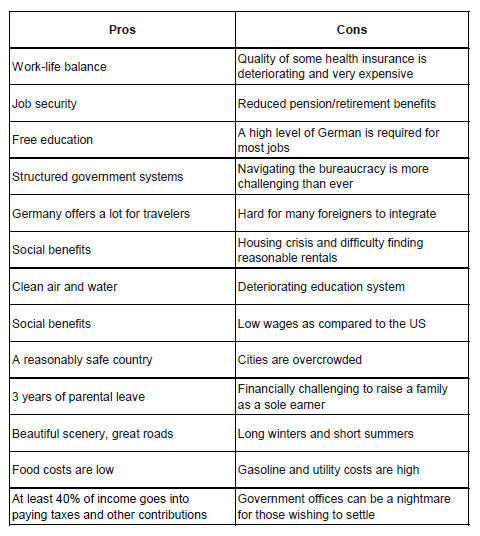
Some Pros and Cons of Living in Germany (as of 2025)
Dictionary
Anmeldung - registration
Arbeitsvertrag - work contract
Aufenthaltserlaubnis - residence permit
Ausländerbehörde - immigration office
Mietvertrag - rental agreement


Wow, I'm so sorry to hear it's been such a tough go this time around! Thank you for sharing though, these are important things for potential expats/immigrants to know.
How do you expect to make a living in Germany when the pay is lower and you can't take a supplemental job without getting permission? I'm sorry you're going through this.